Medieval Meals Made Not-So-Easy (Medieval Mondays #2b)

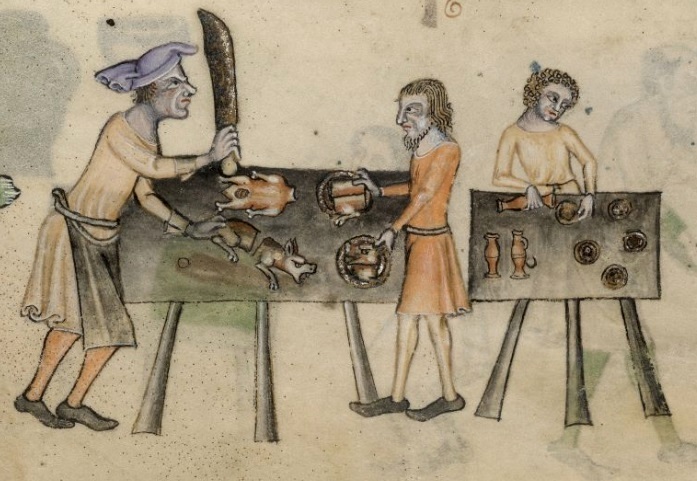
Cooking scene from the Luttrell Psalter (c.1320-1340)

Cooking scene from the Luttrell Psalter (c.1320-1340, Lincolnshire, England)

In the medieval times, our modern emphasis on easy, speedy meals would’ve been an inconceivably foreign concept to a noble family.

In my previous post on medieval food, I discussed the raw ingredients that comprised medieval cookery.

In turning now to discuss how that cookery was done and what recipes often resulted, a key point made by Margaret Wade Labarge, author of Mistress, Maids and Men: Baronial Life in the Thirteenth Century, is as follows:

The medieval baron liked a complicated and highly seasoned dish. (p.118).
Continue reading

Even More Thoughts on Nearing the End

No, I’m still not finished my WIP.

But honest to goodness, this last novel in my historical fiction trilogy is truly almost done.  I know I’ve written about being close before, but now I’m really close. Like, a two-digit number of pages remaining that starts with 2 (or maybe even one!) close.

When last I wrote about my WIP’s impending end, I discussed various insights that had occurred to me as I continued along this process.

Well, a new level of nearness to the end has engendered an all new set of realizations:

Continue reading

What’s On the Menu in the Middle Ages? (Medieval Mondays #2a)

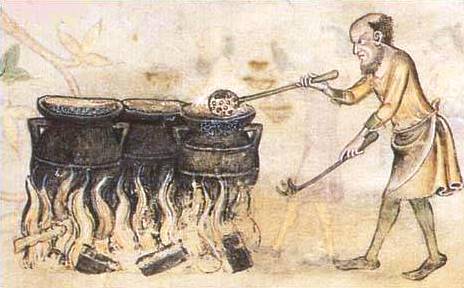
Kitchen scene from the Luttrell Psalter (c.1320-40)

Kitchen scene from the Luttrell Psalter (c.1320-1340, Lincolnshire, England)

If you were magically transported back to early 13th century England and invited to dinner in a noble household, what sort of experience would await you?

An experience so different, it will be the subject of three separate posts in this blog series, the first of which (today’s) focuses on the raw ingredients of medieval cuisine.

Continue reading

Diverse Characters Don’t Have to Earn Their Keep

Glenn from TVs The Walking Dead

Glenn from TV’s The Walking Dead

Although I’ve never watched the show The Walking Dead, it recently became the subject of lengthy conversation in my writers’ group.

The discussion had to do with two specific characters: Michonne (whom I’m told I should consider cosplaying for Halloween) and Glenn, who is Korean-American.

That is to say, the discussion had to do with diverse characters.

Continue reading

Day or Nighttime: When Do You Write? (or, How Much Does the Writing World Love You?)

Working late

I have, at one time or another, both stayed up until and gotten up at every small hour of the morning.

The former of the two – the staying up late – seems to happen, or has happened, mostly in relation to a deadline of some sort, be it one of school or a self-imposed project with a time constraint (e.g. a homemade birthday gift for an out-of-town friend).

(I also recall, during university, having stayed up and out way late at some club, party, or other manner of social gathering, but those days, alas, are largely over now.)

Continue reading

Clothing Made the Medieval Man, Woman & Child (Medieval Mondays #1)

Three versions of Maid Marion (a 13th century character), of which the fox's outfit comes closest.

Three versions of Maid Marian (a 13th century character associated with Robin Hood), of which the more authentic outfit is that of the fox.

If there’s one aspect of medieval history I love most, it’s the clothing, especially women’s clothing.

The clothing, incidentally, is one of the aspects Hollywood most often get wrong.

Typically, this occurs through clothing styles from one century being mis-attributing to another.  This despite what author Mary G. Houston writes in Medieval Costume in England and France: The 13th, 14th and 15th Centuries:

What can be more diverse than the noble simplicity of construction and natural silhouette of the thirteenth century, compared with the slender elegance of the fourteenth, and the riot of variety and exaggeration in the fifteenth century. (pp. v-vi)

Continue reading

The Medieval Times Was No Fairytale

Ever After

I often wonder if I would have enjoyed living in medieval England as much as I do writing about it.

Obviously the answer to this question depends upon a few considerations.  For example, does medieval me look the same as modern me?  There’s no reason to expect she wouldn’t, in which case, I’ll defer to comedian and social critic Louis C.K. for a response:

Continue reading

Is Writing What You Know Holding You Back?

Cracked earth lightbulb

How the hell did “write what you know become” the most opt-repeated piece of writing advice anyway?

Maybe it’s because it’s the first advice many of us ever received.  Certainly it seems like it should be beginner advice.

I can see it perfectly: a student of sixteen or seventeen hunched over his/her desk at school, pencil in hand poised above a sheet of three-hole-punched, lined loose leaf.

(Am I totally dating myself with this memory in longhand?  Do high school students even write by hand  in school anymore?  The pencil in this vision isn’t even mechanical).

Continue reading

On the Responsibility of Writers

What responsibility, if any, does a writer have to society?

This was the question I posted to the message board of the writer’s group I run to be the discussion topic for our next meeting.

I knew at the time of writing it that it was a provocative question – one that different people might interpret in different ways.  Regardless, I was sure it would result in a lively, interesting discussion as my writer’s group meetings always are.

What I didn’t expect, however, was the overwrought response on the message board from an out-of-nowhere, aggrieved and impassioned troll.

Continue reading

5 Habits I Didn’t Know Were Strange Until People Told Me

Well, I found a stock photo of it so it can't be that unusual.

Well, I found a stock photo of it so it can’t be that unusual.

As a writer, I trade upon odd and unusual characteristics.

Conventional writing wisdom says that a story’s protagonist, no matter how much of an everyday, person-in-your-neighbourhood s/he’s meant to represent, should possess some special quality –  something that not only makes him/her memorable but also plays a role in motivating and ultimately resolving the story’s plot.

I mine a lot of my own life in my creation of characters – both my own characteristics and those of people I observe.  I then proceed to spend months and years with these fictional people, to the point that they become like real people to me: fully-realized, self-determining, and with certain traits in common with me.

This, I suppose, has the effect of inuring me to my own oddities.

Continue reading