Medieval Meals Made Not-So-Easy (Medieval Mondays #2b)

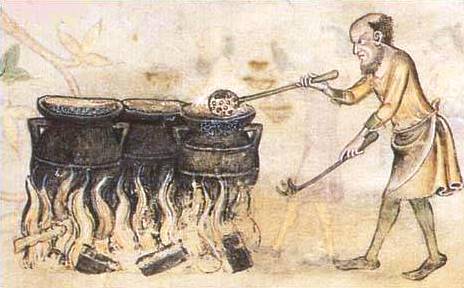
Cooking scene from the Luttrell Psalter (c.1320-1340)

Cooking scene from the Luttrell Psalter (c.1320-1340, Lincolnshire, England)

In the medieval times, our modern emphasis on easy, speedy meals would’ve been an inconceivably foreign concept to a noble family.

In my previous post on medieval food, I discussed the raw ingredients that comprised medieval cookery.

In turning now to discuss how that cookery was done and what recipes often resulted, a key point made by Margaret Wade Labarge, author of Mistress, Maids and Men: Baronial Life in the Thirteenth Century, is as follows:

The medieval baron liked a complicated and highly seasoned dish. (p.118).
Continue reading

What’s On the Menu in the Middle Ages? (Medieval Mondays #2a)

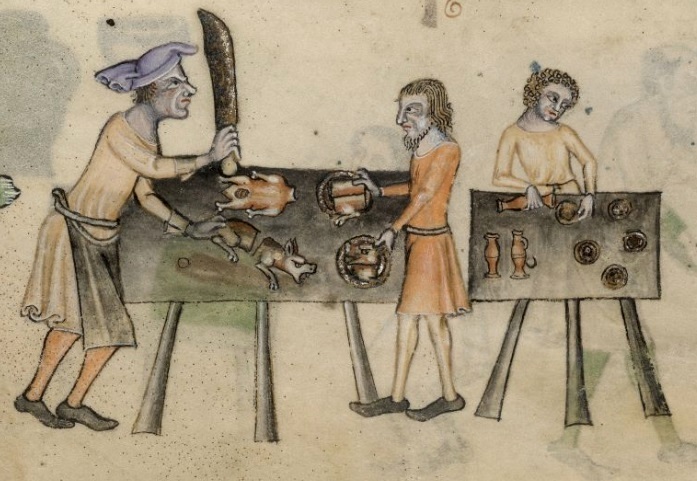
Kitchen scene from the Luttrell Psalter (c.1320-40)

Kitchen scene from the Luttrell Psalter (c.1320-1340, Lincolnshire, England)

If you were magically transported back to early 13th century England and invited to dinner in a noble household, what sort of experience would await you?

An experience so different, it will be the subject of three separate posts in this blog series, the first of which (today’s) focuses on the raw ingredients of medieval cuisine.

Continue reading

Clothing Made the Medieval Man, Woman & Child (Medieval Mondays #1)

Three versions of Maid Marion (a 13th century character), of which the fox's outfit comes closest.

Three versions of Maid Marian (a 13th century character associated with Robin Hood), of which the more authentic outfit is that of the fox.

If there’s one aspect of medieval history I love most, it’s the clothing, especially women’s clothing.

The clothing, incidentally, is one of the aspects Hollywood most often get wrong.

Typically, this occurs through clothing styles from one century being mis-attributing to another.  This despite what author Mary G. Houston writes in Medieval Costume in England and France: The 13th, 14th and 15th Centuries:

What can be more diverse than the noble simplicity of construction and natural silhouette of the thirteenth century, compared with the slender elegance of the fourteenth, and the riot of variety and exaggeration in the fifteenth century. (pp. v-vi)

Continue reading

The Medieval Times Was No Fairytale

Ever After

I often wonder if I would have enjoyed living in medieval England as much as I do writing about it.

Obviously the answer to this question depends upon a few considerations.  For example, does medieval me look the same as modern me?  There’s no reason to expect she wouldn’t, in which case, I’ll defer to comedian and social critic Louis C.K. for a response:

Continue reading

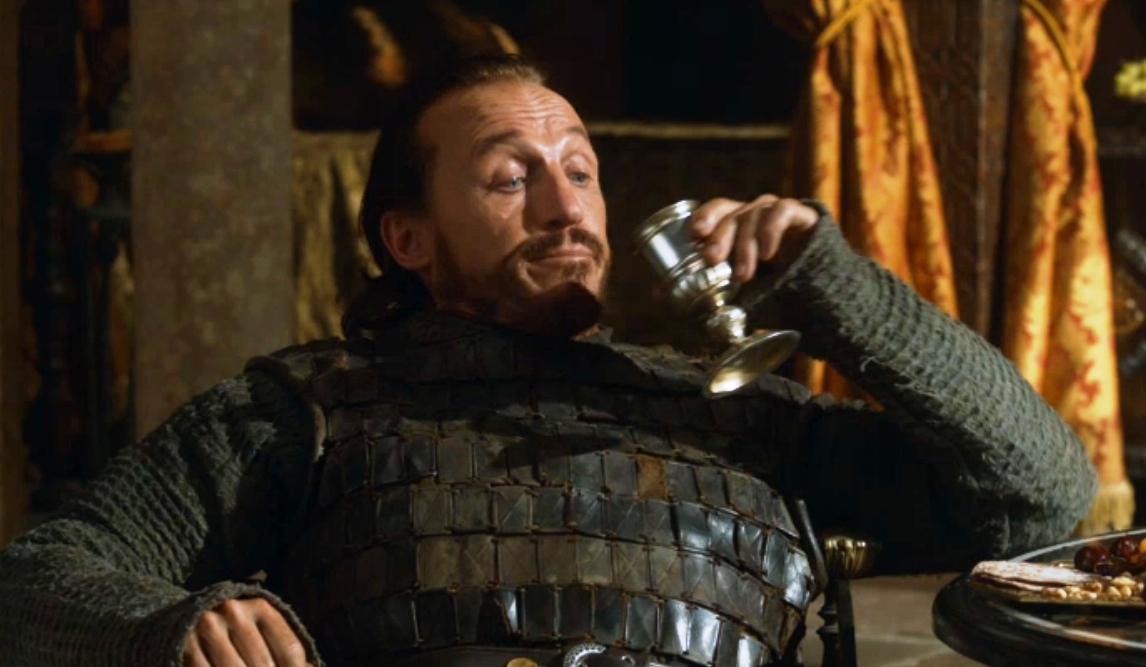
Character Study: Bronn from TV’s Game of Thrones (& what liking him says about me)

Ser Bronn of the Blackwater

Ser Bronn of the Blackwater

Like most people who enjoy TV, I’m following Game of Thrones.

Also like most people, I have my favourite Game of Thrones characters, many of whom have died horrible deaths.

Thankfully, I still have a couple of favourites left, one of whom is Tyrion Lannister’s sellsword bodyguard-turned-knight, the aptly-named Bronn.

Bronn is a secondary character in the series, yet one I’m always excited to watch.  This despite the fact that the roguish soldier of fortune – a hard-drinking, womanizing, wry, cunning, yet still reasonably amiable mercenary – is a common high fantasy trope.

Continue reading

Why I (Literally) Went Medieval on My Writing

There’s a restaurant in Toronto called Medieval Times.

When I was a kid, I would see commercials for it on TV. The gimmick of this restaurant is that it’s set up like a large medieval hall in which patrons are entertained by knights sword fighting and jousting on real horses, all while eating medieval-esque fare without cutlery and drinking out of giant goblets.

To my child self, it looked like the most awesome thing ever. Whenever the commercial (which was more like a movie trailer) came on, I’d stop whatever I was doing and imagine myself going to the restaurant.

Unfortunately, because I was living in Nova Scotia, I never got to go.  I still haven’t been to this day.

Now, I’m writing a novel set in medieval England.

Continue reading

Adventures in Reading: Soldiers of Misfortune

Every reader has a T(o) B(e) R(ead) pile; sometimes a TBR pile that’s years in the making.

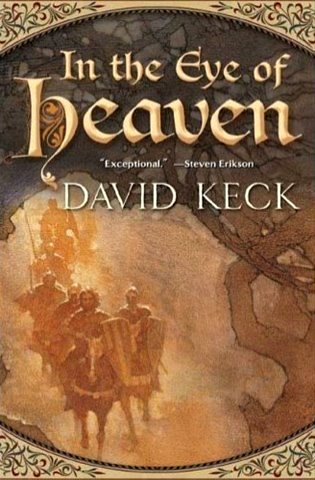
I’m no exception in this regard.  To wit, I’ve been meaning to read the fantasy novel In the Eye of Heaven since its publication in 2007.  Back then, fantasy was my genre of choice, and this book was blurbed by my favourite fantasy author, Jacqueline Carey.

As well, the book’s author – David Keck – is a fellow Canadian and was a debut author in the genre in which I’d hoped to someday be published.

I finally read this book this past May.  It’s success in summiting my eight-years-long TBR pile has a lot to do with its subject matter, as well as my assertion in a previous post that sometimes research for one’s own novel is conducted via fictional sources.

Continue reading