Writing Historical Fiction: A How-NOT-To

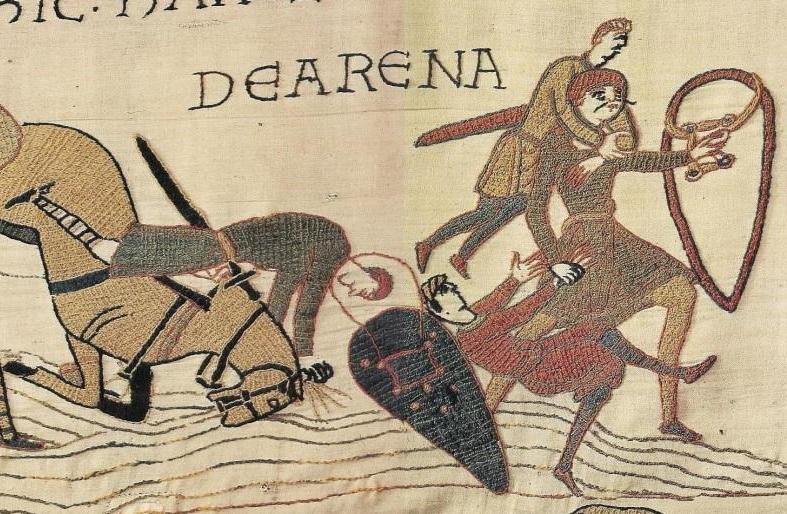
It sucks to be three out of four of these guys.
(The Bayeux Tapestry, 11th Century.)

I never set out to write a historical fiction novel.

If you go back far enough, it can be argued I never set out to write a novel period, for I never believed I’d be able to sustain a story for that length.

But once it did occur to me that I had a novel-length tale to tell, I didn’t expect for it to be a historical one.

As a result of this lack of foresight, the way I’ve gone about writing this novel (technically novels, for there’s two of them; so much for not thinking I could sustain a long story) is definitely not something I’d recommend.

There’s no one right way to write a novel, but what I’ve done may well be the one wrong way to write HF.  Don’t believe me?  Behold my list of what NOT to do, all of which I did, to my detriment.

Continue reading

Adventures in Reading: Soldiers of Misfortune

Every reader has a T(o) B(e) R(ead) pile; sometimes a TBR pile that’s years in the making.

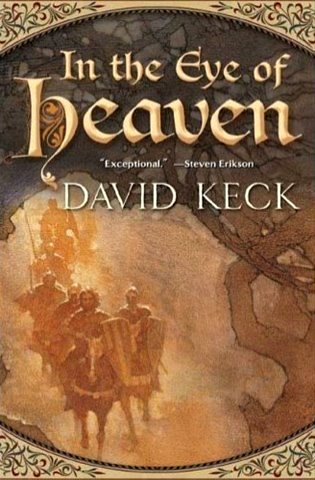
I’m no exception in this regard.  To wit, I’ve been meaning to read the fantasy novel In the Eye of Heaven since its publication in 2007.  Back then, fantasy was my genre of choice, and this book was blurbed by my favourite fantasy author, Jacqueline Carey.

As well, the book’s author – David Keck – is a fellow Canadian and was a debut author in the genre in which I’d hoped to someday be published.

I finally read this book this past May.  It’s success in summiting my eight-years-long TBR pile has a lot to do with its subject matter, as well as my assertion in a previous post that sometimes research for one’s own novel is conducted via fictional sources.

Continue reading

Adventures in Reading: A Monumental Achievement or, When Bad Characters Do Worse

As someone hard at work writing a historical fiction novel, I’ve read a startlingly large number of research books.

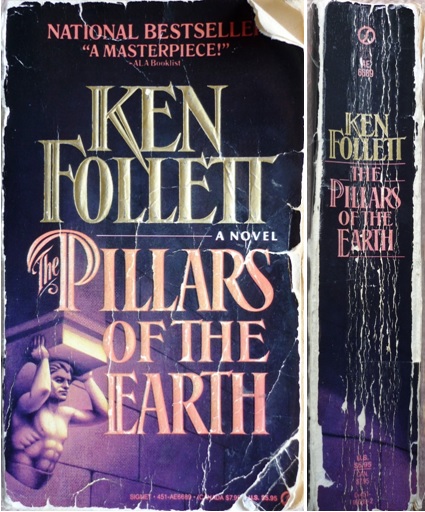
Cover and spine of my worse-for-wear copy of The Pillars of the Earth. Over the course of reading, it eventually became a contest to see which would occur first: me reaching the end or the back cover falling off. The cover won.

Not all of them have been nonfiction.

I suspect that conducting research via fiction is something numerous writers do, and not just those writing historicals.

I’m sure almost every writer has consciously studied existing novels to see how others have handled any number of elements of writing craft, from as broad as character development to as concrete as the number of pages per chapter.

So it was, therefore, that I came to Ken Follett’s The Pillars of the Earth.  Reading this book fell under the purview of “research” for three reasons:

  1. I wanted to study the pacing of such a lengthy (973 pages) novel since my own WIP, though in two novels, will also be a long-ish tale
  2. I wanted to study Follett’s presentation and accuracy of historical details (for all that Pillars takes place about three-quarters of a century earlier than my WIP)
  3. I wanted to read the book before watching the Pillars of the Earth miniseries so I could critique the fidelity of the adaptation in preparation for when my WIP is someday turned into a film.

Cue delusion.

Although, it could happen.  Anything could happen.

I digress.

Continue reading

Strong Female Characters Who Fight Silent Wars

When I was in grade 5 or 6, I read a young adult fantasy novel entitled The Woman Who Rides Like a Man.

This book was the third of a quartet by the wonderful Tamora Pierce about a girl named Alanna who disguises herself as a boy in order to enter training to eventually become a knight of her kingdom.

I loved this book – loved the entire series – and from that moment, a obsession with female fantasy characters who could fight was born.  I couldn’t get enough of stories where women wielded swords, shot bows, fought empty-handed in any sort of martial art, worked as mercenaries, commanded soldiers, and never had to fear for their safety or worry about being disrespected, for they knew how to put jerks in their place.

Stories featuring – as they’re often portrayed within the genres of fantasy and sci-fi – strong female characters.

Continue reading

Adventures in Reading: A tale of two tyrants – part 2

Continued from part 1

Tyrant #2: King John of England, 1167 (b) – 1216 (d)

More people are familiar with King John of England than probably realize.

This is not so much due to his own merits, but rather his frequent association with another, better-known individual from history:

Robin Hood.

(King John, just so you know, was a real historical personage.  Robin Hood, meanwhile – not so much.)

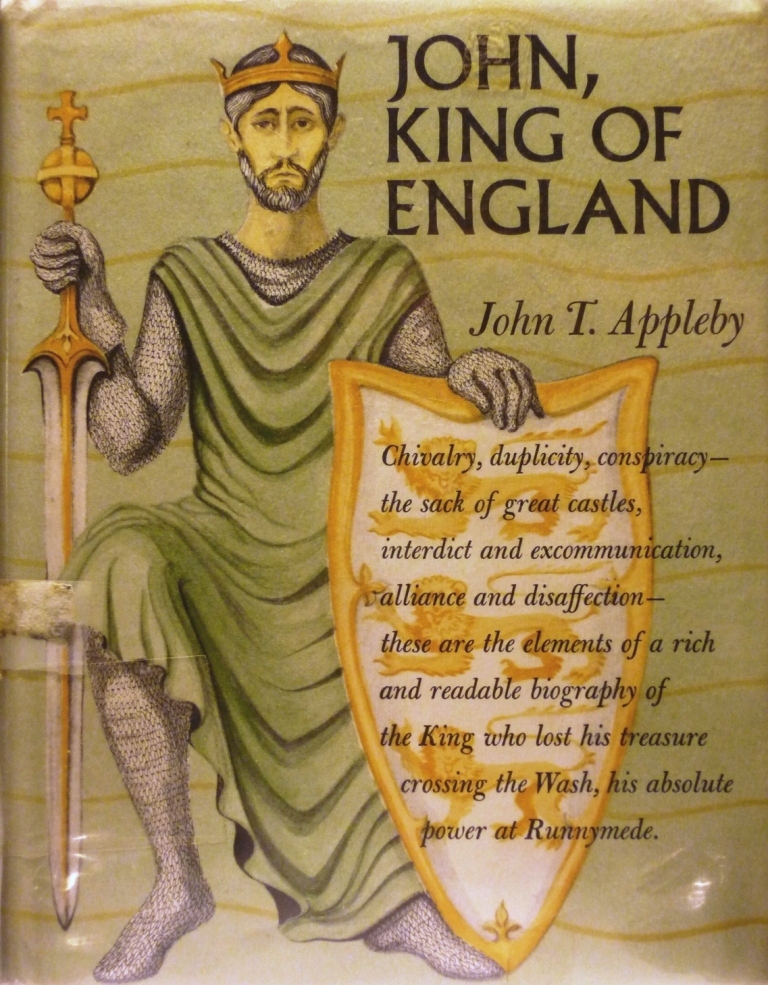
My second half-book for 2013 – John, King of England by John T. Appleby – was an adventure to read because it was a reference book for my novel-in-progress that I had to continue if I wanted the “in progress” bit to remain true.

Yet is was also so dense with historical information, it took forever for me to get through it.  No word of lie, I renewed this book from the library four times for three weeks at a time.

It was also the book that quite decisively taught me how not to go about writing a work of historical fiction, such as I currently am.  But that’s the topic of a whoooole other blog post.

Despite how long it took to read John, King of England, it was very enjoyable.  It was written in a dry, witty style typically attributed to British humour.  For a long time, I assumed the author, John T. Appleby (who died in 1974), was British, only to discover that he was born in Fayetteville, Arkansas, was a Harvard graduate, and at the time of the book’s publication (1959) lived in Washington, D.C.

In the book, I learned about King John’s many failings that made him such a suitable distant villain in the Robin Hood lore.  A small selection:

Continue reading

Writing in the (and What You) Know

(Or, How to Write With Confidence When You’re Not a Subject Matter Expert)

A Distractions & Subtractions post for Rarasaur

The most irritating piece of writing I’ve ever heard first came to me in my youth:

Write what you know.

I was probably about ten years old.

Perhaps you can see the dilemma: what ten-year-old actually knows anything?

The only thing I knew was that I wanted to write, I wanted to write the sort of story I liked to read, and that the sort of stories I liked reading concerned matters that were in no way similar to my unremarkable, ten-year-old life.

My now being 34 years old hasn’t really changed this fact.

And yet, “What what you know” remains one of the most fundamental (and incidentally, fundamentally misunderstood) pieces of writing advice out there.  It can often paralyze writers with doubt that their work lacks credibility, authenticity, and truth.

Continue reading

Building a History – Redux: Where the Streets Have No Name

(A/N: Post title is a play on the song Building a Mystery by Sarah McLachlan and taken from the song Where the Streets Have No Name by U2.)

I am a victim of my own writing predilections, and also a beneficiary of them.

I write historical fiction, but at my core, I treasure the freedom to make and break the rules of the factual and natural world offered by the fantasy genre.

I love learning and writing about how people lived in the distant past, but am less intrigued by stories of real personages out of history, who tend to from the upper classes of society, and instead prefer the historical equivalents to people more like myself.

I’m dedicated to creating a strong sense of place for the reader, for whom distant past settings are likely very alien and divergent from modern life and sensibilities.  Yet not even historians know for 100% certain what in the past was like, thus reference books, Google Maps, and even visiting specific locations in their present-day incarnations can only offer so much insight.

These three writing preferences converge upon a common point, that being the point where there is a gap in recorded history.

I experienced such a gap in my novel-in-progress: in one of the English towns where much of the story takes place, there is no recorded history that I’ve been able to find between the years of 1086 and 1316.  There isn’t conclusive evidence that a castle existed there, but I’ve gone and created one all the same, designing and describing its layout and lifestyle to suit the needs of my story’s plot.

As I mentioned in a previous post within this series, historical fiction and fantasy share a need for detailed world-building, yet differ in that with historical fiction, you have to look all those details up whereas in fantasy, you have to make them all up.

Well, when it comes to places and situations for which there is little recorded history, the historical fiction writer gets to make up stuff as well, thus revealing another meaning to the title of this post series: building a history.

But just how much history does one need to build?

Continue reading

Making a Write Turn (of Phrase)

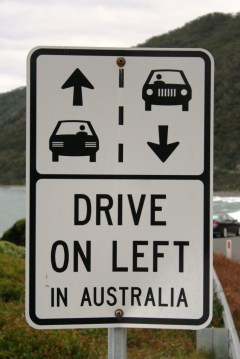
I have a good friend from Australia.

(I swear, this isn’t the start of a limerick.)

My Aussie friend – let’s call her NR – became a friend having been my roommate here in Vancouver for almost two years.  During those years, we spend a tremendous amount of time together, talking about everything under the sun, singing songs, making jokes, arguing, and telling each other how much we love each other.

Needless to say, I’ve come to know her Aussie accent really well.

I’ve already confessed in a previous post to having a penchant for trying to mimic accents and foreign turns of phrase.  Indeed, NR says that having me around is sometimes like an annoying little echo aping her alternate pronunciations –

  • “AH-mund” (“almond”)
  • “ah-loo-MIN-nium” (“aluminium”)
  • “MAS-sage” (“massage” made to sound really kinky)
  • “Douglas FAAH” (“Douglas Fir” – one of the most common tree types found along the coast of British Columbia)

– not to mention her non-North American expressions, such as “reckon” (to perceive or imagine something), “crook” (ill or unwell), “capsicum” (a bell pepper), and my personal favourite, “rear-vision mirror” (the rear-view mirror in a car, which, when spoken in the typical Aussie cadence actually comes out sounding more like “revision mirror”.)

This is all fun and games for me, and NR as well I’m fairly certain, for it’s practically a national pastime among the Australians to “take the piss out of” (tease or make fun of) friends and likewise be a good sport when others take the piss out of you.

However, beyond mere amusement, my interactions with NR have led to think a lot about dialects in general, and how that effects my writing.  For not only do numerous ones tend to exist within a given language, these dialects also vary across time as well geographical space.

In other words, how do I create effective historical dialogue?

Continue reading

Places That Don’t Exist (Anymore)

(A/N: Post title is a play on the song Places That Don’t Exist by Conjure One.)

Two of the first things people want to know upon learning I’m writing is historical fiction novel is where and when it takes place.

The answers, for the record, is England in the early 1200s, but there’s so much more involved in creating a story setting in any genre than just choosing an era and location on a map.  There’s even more to it than just descriptions of what the building and scenery look like.

In his book Characters & Viewpoint, science fiction author Orson Scott Card refers to the setting of a story as the milieu, which he defines as the following:

The milieu is the world surrounding characters – the landscape, the interior spaces, the surrounding cultures[,] … everything from weather to traffic laws.  [It] includes all the physical locations that are used … with all the sights, smells, and sounds that come with the territory.  The milieu also includes the culture – the customs, laws, social roles and public expectations that limit and illuminate all that a character things and feels and says and does. (pp. 48-49).

Readers love to feel as though they’ve been transported into the world of the story.  A large part of that is achieved by creating an authentic setting.  One thing a writer can do to better capture both the structure and mood of where his/her story takes place is to visit the site in real life.  Reference books and Google Maps, after all, can only take you so far.

I indeed visited that part of England where my novel-in-progress is set, however, my novel-in-progress is historical fiction, which means the locale I toured through last summer is a much different place now than it was eight hundred years ago. The specific era of my story setting is long bygone, and very little in its modern incarnation can be back-cast to the past.

This thus leads me to wonder: when it comes to the task of creating a sense of place out of places that don’t exist anymore, is my job as a historical fiction writer easier or more difficult than that of writers of other genres?

Continue reading

Tell It Like It Was

(A/N: Post title is a play on the song Tell It Like It Is by Tracy Chapman.  I don’t know what it is about this series of topics that lends itself well to making post titles out of modified song titles, but I plan to keep rolling with it as far as it will go.)

Every writer has to conduct some manner of research to inform his/her story.

Even when writing a memoir or a tale otherwise drawn completely from personal experience, I’m willing to bet the writer will need to look up or into something, whether it’s the layout of a city or the history of a particular landmark, or the number one single on Billboard at the time.

In historical fiction, however, the research needs are as astronomical as they are minute.  Not only must one research the plans of cities (that may or may not still exist), you also need to know what the roads were paved with.  Information about a landmark might be coupled with that about what was fed to the slaves that built it.  The names of popular songs might be accompanied (no pun intended) by details on what the stringed instruments of the time period were strung with.

And that’s not all; not by a long shot.

Continue reading