
Don’t. The end.
I kid.
(Sort of.)

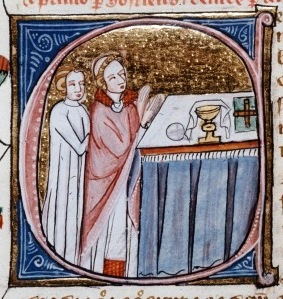
The services it provided contributed to every key turning point in people’s existence. According to John R.H. Moorman, author of Church Life in the Thirteenth Century,
It gave first, the regular worship of the Church on Sundays and weekdays. It gave also the opportunities of Christian baptism, matrimony and burial, together with a little teaching and some spiritual direction mainly administered in the confessional. Further, it offered to the sick and the dying spiritual comfort and perhaps, in some places, medical help as well. (p. 151)

The average modern inhabitant of the western world, even a religious one, might struggle to conceive of how much this was the case.

To begin with, as previously discussed in my post on the feudal system, a “knight’s fee”—that is, the assorted obligations a vassal owed his lord in exchange for the land he lived upon—was both passive and active in nature.

The chivalric ideal
At the same time, few aspects of 13th century medieval history are as grossly misrepresented in mainstream entertainment as the medieval knight.
My previous post about knights in the Middle Ages touched on how the process of becoming a knight involved training in manners, music, and poetry when a young boy was a page, and sacred vigil and dedication of his sword when a squire was elevated to knighthood.

In many ways, it is the knight who seems to embody the spirit of the Middle Ages.
With his horse and sword, his armour, and the perception that he fought with honour and for good, the knight seems to harken back to a simpler time of when the forces of evil had a singular face and could be vanquished with a noble heart and a strong forearm.
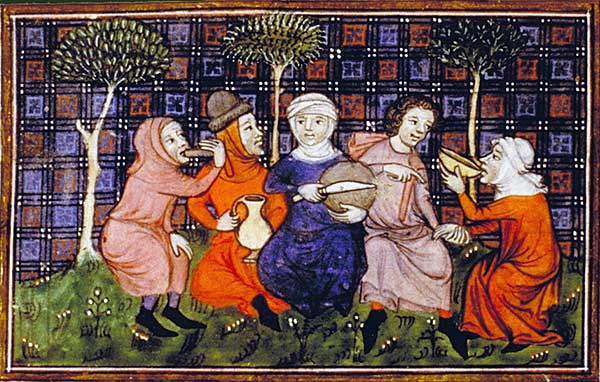
To begin with, the four seasons – marked in accordance with the medieval agricultural calendar – were observed at different times of the year than we recognize then today.
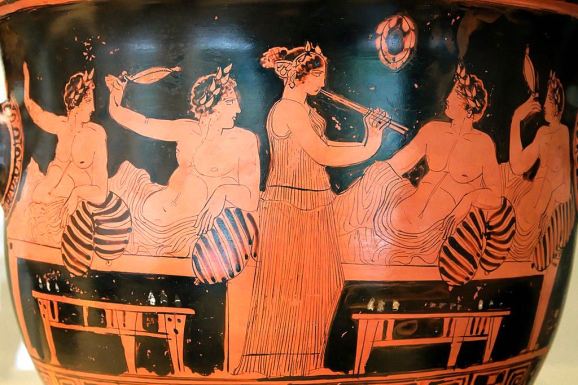
Ancient Greek men at a symposium (being entertained by a female musician) (painted mixing bowl, c. 420 BC)
Ever since I decided my next writing project would be my first (incomplete, shelved) novel – a fantasy – rewritten as historical fiction and set in Ancient Greece, I knew I had to seriously beef up my knowledge of that period in history.
In many ways, this would be me starting from ground zero in my research.

1225 reissue of England’s 1217 Charter of the Forest
To say nothing for the corresponding legend – one that lives on to this day – that grew up surrounding it.
As mentioned in my first post about medieval hunting, forest law stipulated such matters as who was permitted to hunt what and when, what the punishment for poachers would be, and even how many talons were permitted on dogs that lived in households and villages within a royal forest.
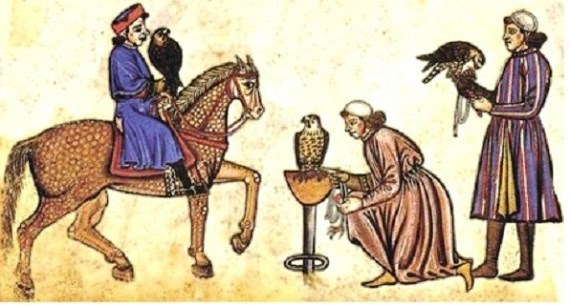
It wasn’t, however, the only way to bring down prey – or even the most popular one, particularly among the noble class.
Neither were deer and boar – which were restricted to all but the king and his favourites – foxes, hares, squirrels, and other beasts of the warren the only quarry that was hunted during the Middle Ages.
 Janna G. Noelle