Adventures in Reading: A Monumental Achievement or, When Bad Characters Do Worse

As someone hard at work writing a historical fiction novel, I’ve read a startlingly large number of research books.
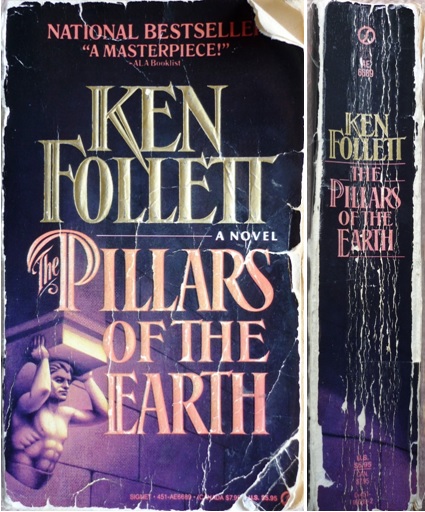
Cover and spine of my worse-for-wear copy of The Pillars of the Earth. Over the course of reading, it eventually became a contest to see which would occur first: me reaching the end or the back cover falling off. The cover won.

Not all of them have been nonfiction.

I suspect that conducting research via fiction is something numerous writers do, and not just those writing historicals.

I’m sure almost every writer has consciously studied existing novels to see how others have handled any number of elements of writing craft, from as broad as character development to as concrete as the number of pages per chapter.

So it was, therefore, that I came to Ken Follett’s The Pillars of the Earth.  Reading this book fell under the purview of “research” for three reasons:

  1. I wanted to study the pacing of such a lengthy (973 pages) novel since my own WIP, though in two novels, will also be a long-ish tale
  2. I wanted to study Follett’s presentation and accuracy of historical details (for all that Pillars takes place about three-quarters of a century earlier than my WIP)
  3. I wanted to read the book before watching the Pillars of the Earth miniseries so I could critique the fidelity of the adaptation in preparation for when my WIP is someday turned into a film.

Cue delusion.

Although, it could happen.  Anything could happen.

I digress.
Continue reading

Strong Female Characters Who Fight Silent Wars

When I was in grade 5 or 6, I read a young adult fantasy novel entitled The Woman Who Rides Like a Man.

This book was the third of a quartet by the wonderful Tamora Pierce about a girl named Alanna who disguises herself as a boy in order to enter training to eventually become a knight of her kingdom.

I loved this book – loved the entire series – and from that moment, a obsession with female fantasy characters who could fight was born.  I couldn’t get enough of stories where women wielded swords, shot bows, fought empty-handed in any sort of martial art, worked as mercenaries, commanded soldiers, and never had to fear for their safety or worry about being disrespected, for they knew how to put jerks in their place.

Stories featuring – as they’re often portrayed within the genres of fantasy and sci-fi – strong female characters.

Continue reading

All You (N)ever Wanted: My favourite (and least favourite) writing advice

Ah – writing advice.

If there’s one thing writers do with as much (if not more!) enthusiasm as actual writing, it’s seeking advice on writing.

The internet positively teems with the stuff.  Plus anyone with even the smallest portion of a novel either on their computer or in their soul is guaranteed to own at least one writing how-to book.

(Personally, I have four, plus a duo tang full of photocopied notes, and numerous downloaded webpages.)

But how much this boundless writing advice is of practical use?  At a recent meetup of the writing group I lead, this was the discussion topic du jour: writing advice – the good, the bad, and the ugly.  Everyone was to come prepared to share the best piece(s) of writing advice they’d ever heard/read/received, and the worst piece(s).

I have five pieces of favourite writing advice – the specific tips that have really stuck with me over the years, and helped me straighten out some of my own writing flaws.  And so, I give you…

Continue reading

Write a Novel to Change People, to Change Yourself and the World, for the Better

(A/N: This post is in honour of the victims, the emergency staff, and those in mourning in Boston)

I was on the treadmill, running, as the devastating events surrounding the Boston Marathon were unfolding.

Because of the time difference between Boston and Vancouver, BC, it was my lunch hour, which, as usual, saw me in the gym located beneath my office.

I was enjoying my run that day, which is by no means a guaranteed occurrence.  Afterward, to commemorate, I took to Twitter to convey my delight in how just the right song coming up on one’s iTunes shuffle at just the right time (such as during the final five-minute sprint) can transform an otherwise good run into one that’s AWESOME and KICKASS and makes you feel able to CONQUER THE WORLD!

It was then that I took a closer look at the content of all those #Boston tweets filling my Twitter stream….

Continue reading

Line By Line, Stone By (Mile)Stone

This past week, I reached another milestone in my novel-in-progress:

Page 200.

Except it’s not really my 200th page, for my story is a novel in two volumes (like how Lord of the Rings is actually a novel in three volumes rather than the trilogy it’s often erroneously termed).  The first volume of the story in draft form is 377 pages.

That means I’m technically on page 577.

The past two months has seen me achieve a number of writing milestones: my current page number; my one-year blogging anniversary on February 20; my writer’s birthday (which I actually missed) on February 10.

I’m now a five-year-old writer.

Continue reading

The Kelly Clarkson Method of Plotting: Throwing a twist in the tale

Have you ever heard Kelly Clarkson’s 2005 song Because of You?

The other day, I was trying to assemble a soundtrack for my novel-in-progress, and the song came up on my iTunes:

[Chorus] Because of you I never stray too far from the sidewalk / Because of you I learned to play on the safe side so I don’t get hurt / Because of you I find it hard to trust not only me, but everyone around me / Because of you I am afraid

If you want, you can have a listen to the whole thing here:

While this song didn’t make my soundtrack, I like it nonetheless, for whenever I hear it, it recalls me to an important consideration regarding plots and predictability.

Continue reading

Adventures in Reading: A tale of two tyrants – part 2

Continued from part 1

Tyrant #2: King John of England, 1167 (b) – 1216 (d)

More people are familiar with King John of England than probably realize.

This is not so much due to his own merits, but rather his frequent association with another, better-known individual from history:

Robin Hood.

(King John, just so you know, was a real historical personage.  Robin Hood, meanwhile – not so much.)

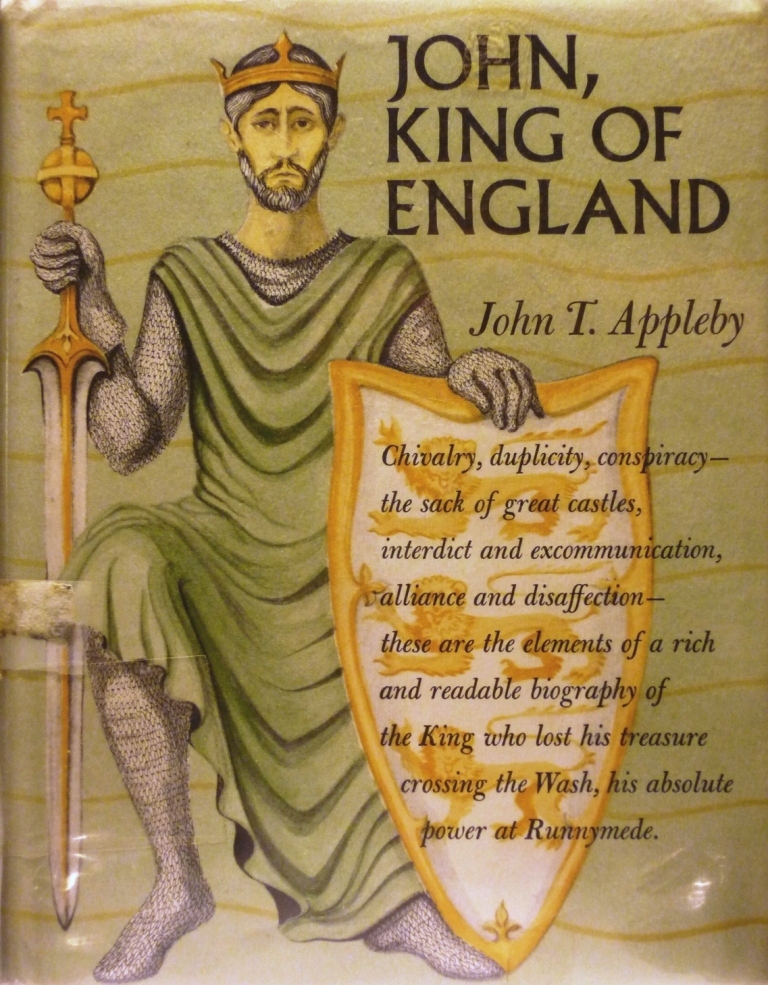
My second half-book for 2013 – John, King of England by John T. Appleby – was an adventure to read because it was a reference book for my novel-in-progress that I had to continue if I wanted the “in progress” bit to remain true.

Yet is was also so dense with historical information, it took forever for me to get through it.  No word of lie, I renewed this book from the library four times for three weeks at a time.

It was also the book that quite decisively taught me how not to go about writing a work of historical fiction, such as I currently am.  But that’s the topic of a whoooole other blog post.

Despite how long it took to read John, King of England, it was very enjoyable.  It was written in a dry, witty style typically attributed to British humour.  For a long time, I assumed the author, John T. Appleby (who died in 1974), was British, only to discover that he was born in Fayetteville, Arkansas, was a Harvard graduate, and at the time of the book’s publication (1959) lived in Washington, D.C.

In the book, I learned about King John’s many failings that made him such a suitable distant villain in the Robin Hood lore.  A small selection:

Continue reading

Switching Teams: Pinch-hitting for the pantsers

I’ve always been a plotter – or perhaps I should say always had been.

In the past in this blog, I’ve written about how I’m left-brained, how I love rules, how I think about my writing constantly, how I try to plan everything, and indeed, how I feel paralysed to start a work of fiction unless I know, at least in a broad sense, how it’s going to end.

That is to say, I’m probably the last person anyone would expect take the proverbial walk to the other side of the field.

And yet, to quote myself in a recent Tweet:

How did it come to this?  By virtue of each of the following:

Continue reading

Don’t Talk About Fight Club: A writer’s paranoia in discussing a WIP

“What’s your novel about?”

Four simple words that never fail to strike terror in my heart.

Part of this is because such a simple query is seeking an equally concise reply – the dreaded “elevator pitch”, which is an art form of brevity on par with the haiku and the perfectly witty Tweet.  Plus, I’m almost never as glib a speaker as I wish when put on the spot like that.

As well, I dislike stating definitively that my WIP is the story of XYZ, when the end result may well come to be significantly different.

Stories are like life: more possibilities and purpose emerge the further along you go.  And just like life, it’s rather invalid to summarize the meaning of it all before it has approached its ultimate end.

Finally, I fear opening myself up to premature criticism of my plot through my inability to properly explain it while still in progress.  Or conversely, premature interest, and subsequent probing questions.

As a result of all this, when Australian historical fiction author Debbie Robson asked me to participate in the blog meme known as The Next Big Thing, I said, “Sure.”

Because why be consistent with one’s own personality traits?

Admittedly, I did offer the caveat that my answers would be vague, superstitious, and paranoiac since I am indeed all of the above.  Furthermore, having since put my blog on its 600-word diet gives me even more of an excuse to be equivocal.  Thus, without further ado:

Continue reading