Story Math Sucks

Every so often on social media I’ll encounter a post that seems wholly and deliberately written for me.

In the four years since I last put fingers to keys in support of this blog, I’ve sadly yet to overcome my tendency to put fingers to keys in far too great an amount to be of service to the accepted length of a standard traditionally published novel.

That is to say, I remain, as ever, an overwriter.
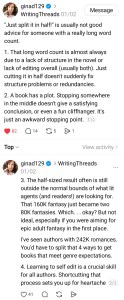
In the 180K(!) words of my latest historical WIP’s first draft that I’ve laboriously written (because I find all writing laborious, really, rather than this being some special case), there is, fortunately, a natural endpoint where I can cut the story into two.

But cutting in two is not the same thing as cutting in half. With my new, proper midpoint as a guidepost, I now have to remove at least 15K words from the first half of book 1 and add 8K to the second half to rebalance the plot structure.

Oh, and the so-called “book 2” I now have on my hands? It’s less than half the length of a normal novel.

Story math, y’all.

But I have a plan for this. I have a complicated, multi-phase plan to fix all of these challenges I’ve both inadvertently and inevitably created for myself. I may have even finally—finally—learned my lesson on proper story structure and pacing during the drafting stage.

But what a road it’s been—it still is, currently—to get here.

~

The reality of how long it’s been since I’ve last had a completed first draft to push and pull into shape is itself another wrinkle of story math resulting from the two key facts I mentioned above—that I’m an overwriter and that all writing is laborious to me. Even blogging. Yet here I am. Again. Maybe…. For now, I’m just dipping my toe back into the blogosphere. No committed posting schedule. No comments either, for now. We’ll see how this—how all of this—goes in due course.


(Post header image from imgflip)
Thoughts on Reading Through the Rest of My Novel

It was a tweet I could have written myself:

(At least the first part of the tweet; it’s pretty hard to create a duology out of a story that’s already been envisioned as a trilogy!)

Continue reading

Learning by Doing (Over): Even More Thoughts on Having My Novel Critiqued

Apparently, I’m both a better and worse writer than I always thought.

It’s been pretty much a full year since I started my critique group, and the time I’ve spend working with my CPs has been full of revelations about myself as a writer.

Continue reading

My Year-End 2018 Goals Reassessment (New Year’s Resolution Redux #3)

I’ve got one more kick at the can.

I’m a long-standing lover of New Year’s resolutions, and this year, aside from just setting some—which is the easy part—I decided to perform regular progress assessments in order to course correct as needed to help boost my likelihood of achieving success.

Continue reading

On Validation During the Writing Process (and why it’s okay for writers to want that too)

I’ve written before on the topic of writers and validation.

That previous post was related to which form of publishing one might chose to pursue (self-publishing vs. traditional), and what that choice may or may not say about one’s need for acknowledgement by writing industry professionals, which in turn may or may not relate to the strength of one’s self esteem.

Continue reading

“Mistakes Were Made”: More Thoughts on Having My Novel Critiqued

I always believed that I was a good writer.

This is a fairly common trait among writers and not necessarily a bad thing.  No one would spend the necessary months or years to write a novel if they didn’t on some level believe themselves good at it, or at least capable of getting better.

Continue reading

Some Positive Affirmations to Guide You (and Me) Through the Writing Critique Process

Writing is not a team sport, except for when it eventually becomes one.

Overall, I consider writing the most solitary of the arts.  Not only does writing a novel involve spending months, if not longer, alone inside one’s head trying to reproduce the drama unfolding therein, the interim stages of an unfinished novel hold next to no interest.

Continue reading