On Suspense in Storytelling, pt. 2 – Unpredictable-Unputdownable

Every story, by definition, contains suspense in one form or another.

The most common form is the Predictable-Yet-Still-Desirable (from pt. 1), wherein the reader/viewer already has a pretty good idea of what’s going to happen before it happens, but wants to see it anyway.

This may be either to feel the satisfaction of having been correct in his/her predictions, to see exactly how it happens, or to be already emotionally prepared to vicariously undergo a universal human experience.

Somewhat less common is a second form of suspense, which, ironically, is probably the form that more readily comes to mind when one hears the word “suspense”: the unpredictable-and-thus-unputdownable, which keeps the reader glued to the book, and still reading long after s/he should have gone to bed.

All stories by their very nature contain the precursors of this type of suspense.  How could they not?  Stories come to us described by blurbs designed to hint at the plot and its major turning points, but ultimately give nothing away.

They’re the very definition of suspense, for who knows what might happen between the lines of that enticing paragraph on the back of the book or DVD case?

Not all stories, however, retain that suspense.
Continue reading

Adventures in Reading: A Monumental Achievement or, When Bad Characters Do Worse

As someone hard at work writing a historical fiction novel, I’ve read a startlingly large number of research books.

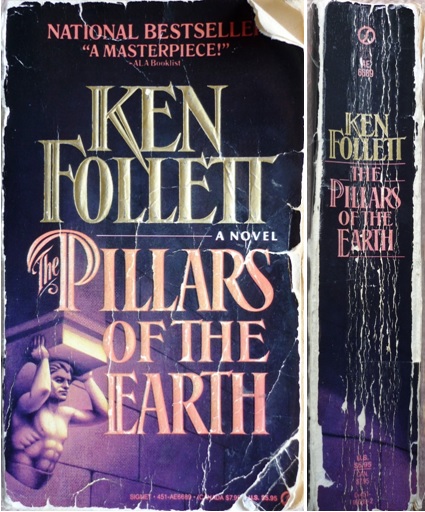
Cover and spine of my worse-for-wear copy of The Pillars of the Earth. Over the course of reading, it eventually became a contest to see which would occur first: me reaching the end or the back cover falling off. The cover won.

Not all of them have been nonfiction.

I suspect that conducting research via fiction is something numerous writers do, and not just those writing historicals.

I’m sure almost every writer has consciously studied existing novels to see how others have handled any number of elements of writing craft, from as broad as character development to as concrete as the number of pages per chapter.

So it was, therefore, that I came to Ken Follett’s The Pillars of the Earth.  Reading this book fell under the purview of “research” for three reasons:

  1. I wanted to study the pacing of such a lengthy (973 pages) novel since my own WIP, though in two novels, will also be a long-ish tale
  2. I wanted to study Follett’s presentation and accuracy of historical details (for all that Pillars takes place about three-quarters of a century earlier than my WIP)
  3. I wanted to read the book before watching the Pillars of the Earth miniseries so I could critique the fidelity of the adaptation in preparation for when my WIP is someday turned into a film.

Cue delusion.

Although, it could happen.  Anything could happen.

I digress.

Continue reading

Strong Female Characters Who Fight Silent Wars

When I was in grade 5 or 6, I read a young adult fantasy novel entitled The Woman Who Rides Like a Man.

This book was the third of a quartet by the wonderful Tamora Pierce about a girl named Alanna who disguises herself as a boy in order to enter training to eventually become a knight of her kingdom.

I loved this book – loved the entire series – and from that moment, a obsession with female fantasy characters who could fight was born.  I couldn’t get enough of stories where women wielded swords, shot bows, fought empty-handed in any sort of martial art, worked as mercenaries, commanded soldiers, and never had to fear for their safety or worry about being disrespected, for they knew how to put jerks in their place.

Stories featuring – as they’re often portrayed within the genres of fantasy and sci-fi – strong female characters.

Continue reading

Places That Don’t Exist (Anymore)

(A/N: Post title is a play on the song Places That Don’t Exist by Conjure One.)

Two of the first things people want to know upon learning I’m writing is historical fiction novel is where and when it takes place.

The answers, for the record, is England in the early 1200s, but there’s so much more involved in creating a story setting in any genre than just choosing an era and location on a map.  There’s even more to it than just descriptions of what the building and scenery look like.

In his book Characters & Viewpoint, science fiction author Orson Scott Card refers to the setting of a story as the milieu, which he defines as the following:

The milieu is the world surrounding characters – the landscape, the interior spaces, the surrounding cultures[,] … everything from weather to traffic laws.  [It] includes all the physical locations that are used … with all the sights, smells, and sounds that come with the territory.  The milieu also includes the culture – the customs, laws, social roles and public expectations that limit and illuminate all that a character things and feels and says and does. (pp. 48-49).

Readers love to feel as though they’ve been transported into the world of the story.  A large part of that is achieved by creating an authentic setting.  One thing a writer can do to better capture both the structure and mood of where his/her story takes place is to visit the site in real life.  Reference books and Google Maps, after all, can only take you so far.

I indeed visited that part of England where my novel-in-progress is set, however, my novel-in-progress is historical fiction, which means the locale I toured through last summer is a much different place now than it was eight hundred years ago. The specific era of my story setting is long bygone, and very little in its modern incarnation can be back-cast to the past.

This thus leads me to wonder: when it comes to the task of creating a sense of place out of places that don’t exist anymore, is my job as a historical fiction writer easier or more difficult than that of writers of other genres?

Continue reading

Only in the Past

(A/N: Post title is taken from the song of the same name by The Be Good Tanyas.)

What exactly is historical fiction, anyway?

I’ve been actively writing it for five months now, and thought about writing it for at least two years prior to that.  But it’s only in the past two months that I’ve actually stopped to ponder what historical fiction is really all about as a category of novels.

I have a blogger that I follow to thank for this period of reflection.  Over at the blog entitled On Becoming a Wordsmith, historical fiction writer Elaine Cougler has been generating good discussion on this topic, starting with this post and continuing with this one.

According to Elaine (quoting Wikipedia), at its simplest, historical fiction is defined as follows:

Historical fiction tells a story that is set in the past. That setting is usually real and drawn from history, and often contains actual historical persons, but the main characters tend to be fictional. Writers of stories in this genre, while penning fiction, attempt to capture the manners and social conditions of the persons or time(s) presented in the story, with due attention paid to period detail and fidelity.

From what I gather from the discussion over at Elaine’s blog, the historical fiction genre (and I use the term “genre” very loosely here, as the second post I’ve linked above raises the issue of whether historical fiction is truly a genre at all), can be further divided into two broad subcategories:

a) Stories that contain actual historical personages and historically accurate events.

b) Stories in which the era and location they’re set in is historically accurate, but the characters (and perhaps even the events as well) are fictitious.

Continue reading

In (Sorta) Support of Fan Fiction – finale

(Continued from Part 1, Part 2 – The Good, Part 3 – The Bad, and Part 4 – The Ugly)

Conclusion

Love it or hate it, fan fiction is here to stay, at least for the foreseeable future.

Continue reading

In (Sorta) Support of Fan Fiction, pt. 3

(Continued from Part 1 and Part 2 – The Good)

The Bad

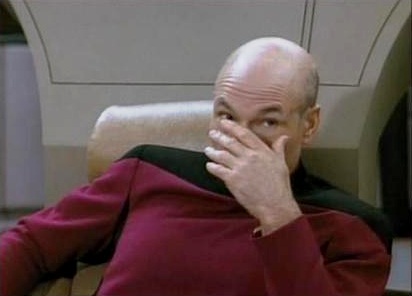
We all know that feeling (and, no, the Enterprise smells just fine).

I began this examination of fan fiction in response to two online articles I stumbled across on the subject on the same day: one from Time and the other found here at Flavorwire.com.  I felt inclined to throw in a bit of support for fan fiction given that I started out in my youth as a fanfic writer – something I believe has helped me develop into the writer of original fiction that I am today.

In my first two posts, I reminisced about fun times spent writing in fandoms with friends, and also looked more closely at why writing fanfic can be educational for developing writers, yet why one shouldn’t assume that all fanfic writers are developing writers.

My goal for this series of posts, however, in the same vein as both of the aforementioned online articles, is to be balanced.  So, having already covered the good of fan fiction, we now come to the bad.

Continue reading

In (Sorta) Support of Fan Fiction, pt. 2

(Continued from Part 1)

The Good

I was in grade 11 when I took my first, much-loved, creative writing class.  Except, I don’t actually believe that was my first class.  I think writing fan fiction gave me a far earlier education in writing craft.

I truly do believe this, for writing fanfic offered me ready-made access to what is often the most difficult part of a story to devise from scratch.

Characters.

Continue reading