Adventures in Reading: A Monumental Achievement or, When Bad Characters Do Worse

As someone hard at work writing a historical fiction novel, I’ve read a startlingly large number of research books.
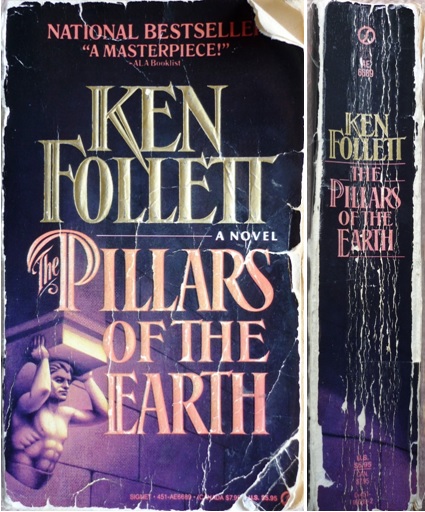
Cover and spine of my worse-for-wear copy of The Pillars of the Earth. Over the course of reading, it eventually became a contest to see which would occur first: me reaching the end or the back cover falling off. The cover won.

Not all of them have been nonfiction.

I suspect that conducting research via fiction is something numerous writers do, and not just those writing historicals.

I’m sure almost every writer has consciously studied existing novels to see how others have handled any number of elements of writing craft, from as broad as character development to as concrete as the number of pages per chapter.

So it was, therefore, that I came to Ken Follett’s The Pillars of the Earth.  Reading this book fell under the purview of “research” for three reasons:

  1. I wanted to study the pacing of such a lengthy (973 pages) novel since my own WIP, though in two novels, will also be a long-ish tale
  2. I wanted to study Follett’s presentation and accuracy of historical details (for all that Pillars takes place about three-quarters of a century earlier than my WIP)
  3. I wanted to read the book before watching the Pillars of the Earth miniseries so I could critique the fidelity of the adaptation in preparation for when my WIP is someday turned into a film.

Cue delusion.

Although, it could happen.  Anything could happen.

I digress.
Continue reading

On Truth in Storytelling

I have one more piece of favourite writing advice I was unable to fit into my previous post on that subject.

It’s a writing tip whose source I unfortunately can no longer recall.  I’ve searched through all my writing how-to books, photocopied pages, and notes I’ve taken in various journals over the years, but I’ve been unable to find it again:

The job of a story isn’t to tell what’s true; it’s to tell what people believe.

It’s a rather bald statement, to say the least – one that’s stuck with me for years.  It’s yet another touchstone I’ve tried to apply to all my writing, ironically, without even knowing how it’s writer meant for it to be interpreted, for I can’t remember that either.

What does it mean?  I’ve spent the last year and a half since I started writing again searching for an answer to that question.

I believe I’ve found two.

Continue reading

Strong Female Characters Who Fight Silent Wars

When I was in grade 5 or 6, I read a young adult fantasy novel entitled The Woman Who Rides Like a Man.

This book was the third of a quartet by the wonderful Tamora Pierce about a girl named Alanna who disguises herself as a boy in order to enter training to eventually become a knight of her kingdom.

I loved this book – loved the entire series – and from that moment, a obsession with female fantasy characters who could fight was born.  I couldn’t get enough of stories where women wielded swords, shot bows, fought empty-handed in any sort of martial art, worked as mercenaries, commanded soldiers, and never had to fear for their safety or worry about being disrespected, for they knew how to put jerks in their place.

Stories featuring – as they’re often portrayed within the genres of fantasy and sci-fi – strong female characters.

Continue reading

All You (N)ever Wanted: My favourite (and least favourite) writing advice

Ah – writing advice.

If there’s one thing writers do with as much (if not more!) enthusiasm as actual writing, it’s seeking advice on writing.

The internet positively teems with the stuff.  Plus anyone with even the smallest portion of a novel either on their computer or in their soul is guaranteed to own at least one writing how-to book.

(Personally, I have four, plus a duo tang full of photocopied notes, and numerous downloaded webpages.)

But how much this boundless writing advice is of practical use?  At a recent meetup of the writing group I lead, this was the discussion topic du jour: writing advice – the good, the bad, and the ugly.  Everyone was to come prepared to share the best piece(s) of writing advice they’d ever heard/read/received, and the worst piece(s).

I have five pieces of favourite writing advice – the specific tips that have really stuck with me over the years, and helped me straighten out some of my own writing flaws.  And so, I give you…

Continue reading

Vices and Devices: Best Tech for Writers (you might be surprised…)

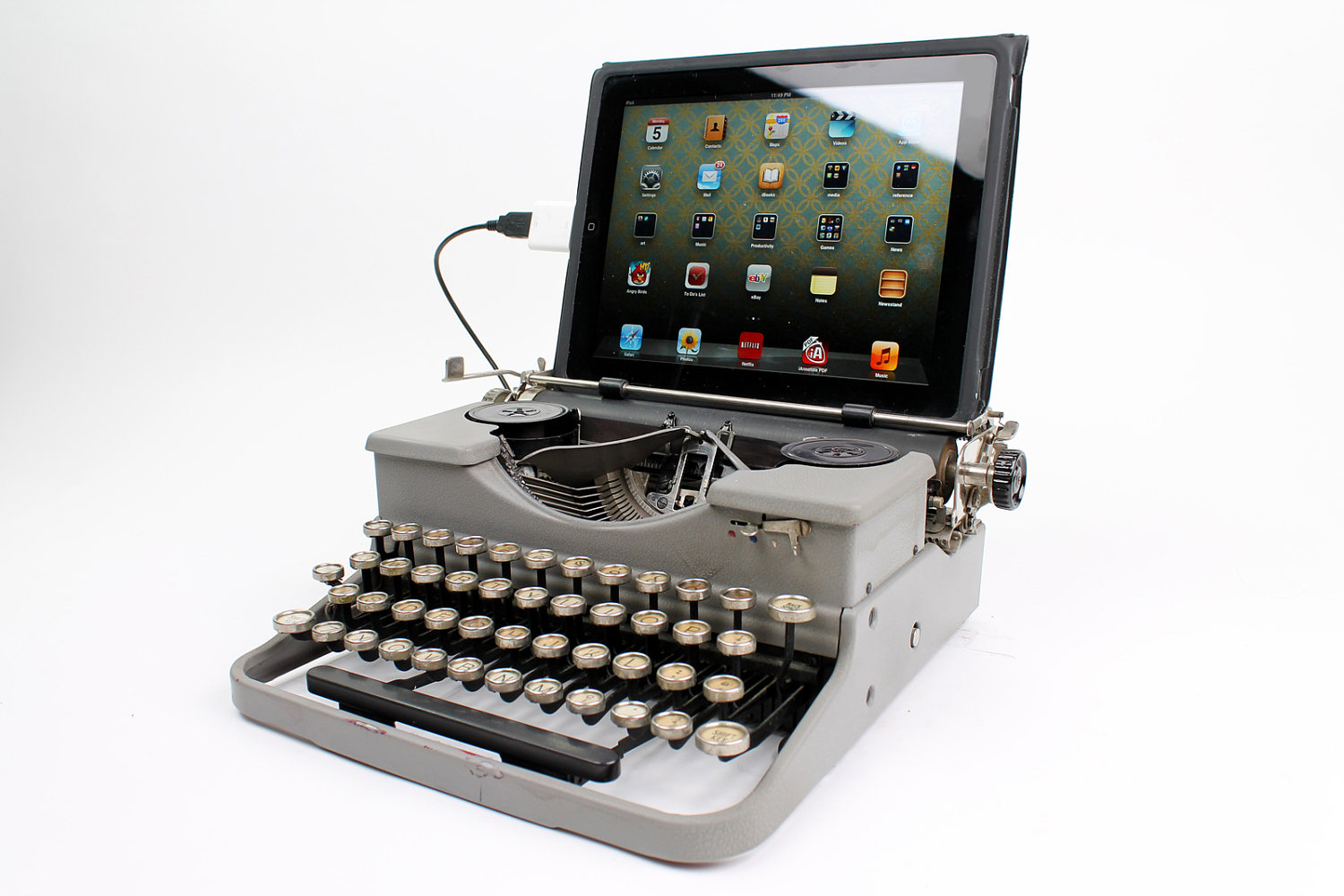
Ask any group of writers what technology they can’t live without and you’ll get the same handful of answers…

Computer…

iPad…

Internet…

Scrivener…

The voice-recording app on one’s phone…

…over and over again.

(Rare is the astute writer who notes I in no way specified writing-related technology.  Few ever answer “my fridge” or “my stove” or “my furnace in the dead of winter”.)

The problem with writing-related tech is that it does little to account for the writing life as a whole.

As a point of comparison, consider the important markers that define a healthy lifestyle: sure, exercising five days a week will give you a hard, hot body that will turn heads on any beach.  But if you’re also an insomniac, chain-smoking stress cadet, how healthy can you truly claim to be?

Writing is no different.  Getting words down on a page is just the tip of the proverbial iceberg; there’s a lot more supporting it beneath the surface that’s not readily seen.

Here’s some tech that helps me, at least, take care of, not just the writing, but also the person doing the deed, to promote a more holistic writing life:

Continue reading

Write a Novel to Change People, to Change Yourself and the World, for the Better

(A/N: This post is in honour of the victims, the emergency staff, and those in mourning in Boston)

I was on the treadmill, running, as the devastating events surrounding the Boston Marathon were unfolding.

Because of the time difference between Boston and Vancouver, BC, it was my lunch hour, which, as usual, saw me in the gym located beneath my office.

I was enjoying my run that day, which is by no means a guaranteed occurrence.  Afterward, to commemorate, I took to Twitter to convey my delight in how just the right song coming up on one’s iTunes shuffle at just the right time (such as during the final five-minute sprint) can transform an otherwise good run into one that’s AWESOME and KICKASS and makes you feel able to CONQUER THE WORLD!

It was then that I took a closer look at the content of all those #Boston tweets filling my Twitter stream….

Continue reading

On Validation, and why it’s okay for writers to want it

"I've wanted more than anything to have your respect....  And I can't deny the fact that you like me, right now, you like me!" (from actress Sally Field's 1985 Academy Award acceptance speech)

“I’ve wanted more than anything to have your respect…. And I can’t deny the fact that you like me, right now, you like me!” (from actress Sally Field’s 1985 Academy Award acceptance speech).


This issue of validation keeps coming up within the traditional vs. self-publishing debate.

For some time now, I’ve been reading various blog posts and articles discussing the merits of one form of publishing compared to the other, particularly as related to the aspirations of unpublished writers.

This debate is nothing new – indeed, it’s been going for so long now as to be almost institutionalized, complete with its own special vocabulary: “gatekeepers”, “credibility”, “the gauntlet”, “vetting process”, “the old guard”, “the new order”, “the publishing revolution”, “the Big 6, 5, 4, etc.”

However, over the past two weeks, a new vocabulary word has appeared on the scene, predominantly in disparaging reference to writers seeking a deal with a traditional publisher:

Validation.

Or better put: the desire for acceptance by and praise from the agents and editors of traditional publishing as opposed to the potentially greater monetary rewards of self-publishing.

Continue reading

Line By Line, Stone By (Mile)Stone

This past week, I reached another milestone in my novel-in-progress:

Page 200.

Except it’s not really my 200th page, for my story is a novel in two volumes (like how Lord of the Rings is actually a novel in three volumes rather than the trilogy it’s often erroneously termed).  The first volume of the story in draft form is 377 pages.

That means I’m technically on page 577.

The past two months has seen me achieve a number of writing milestones: my current page number; my one-year blogging anniversary on February 20; my writer’s birthday (which I actually missed) on February 10.

I’m now a five-year-old writer.

Continue reading

The Kelly Clarkson Method of Plotting: Throwing a twist in the tale

Have you ever heard Kelly Clarkson’s 2005 song Because of You?

The other day, I was trying to assemble a soundtrack for my novel-in-progress, and the song came up on my iTunes:

[Chorus] Because of you I never stray too far from the sidewalk / Because of you I learned to play on the safe side so I don’t get hurt / Because of you I find it hard to trust not only me, but everyone around me / Because of you I am afraid

If you want, you can have a listen to the whole thing here:

While this song didn’t make my soundtrack, I like it nonetheless, for whenever I hear it, it recalls me to an important consideration regarding plots and predictability.

Continue reading