Living an Artist’s Life in a Workaday World

(A How-To)

A Distractions & Subtractions post for Dianne Gray
It’s hard to know whether there’s been an era more detrimental to living the life of an artist than the current one.

The temptation is certainly strong to say there hasn’t been – that the Ancient Greeks, Romans, and Egyptians, the Renaissance (wo)men, the Elizabethans, and the Romantics with their sculpture and architecture, their mosaics and genre scenes, their busts and paintings, their music, literature and frescos, their theatre, and their landscape-focused writing, painting, and composing that seem to burst from the pages of history texts all revered their artists.

Maybe they did.

But perhaps their artists suffered the historical equivalent to what many artists face today – that is to say, a stifling daily grind of the working world with all its attendant hassles that is the sworn enemy of creativity.

There’s the commuting, the budgets, deadlines, overtime, stagnation, trying to do more with less, spending more hours a week at work than not at work, and the constant competition for more, better, and now that exemplifies a consumer-based economy.

All of these practicalities of life leave the modern artistically-inclined especially feeling drained, de-animated, and deprived of the space, reflection, and deliberation required to let loose their imaginations and give their creative musings a tangible form.

Such is no different for national/international award winning Australian author Dianne Gray, whose writing subtraction speaks wholly to this artist/workaday dichotomy many of us struggle to reconcile.

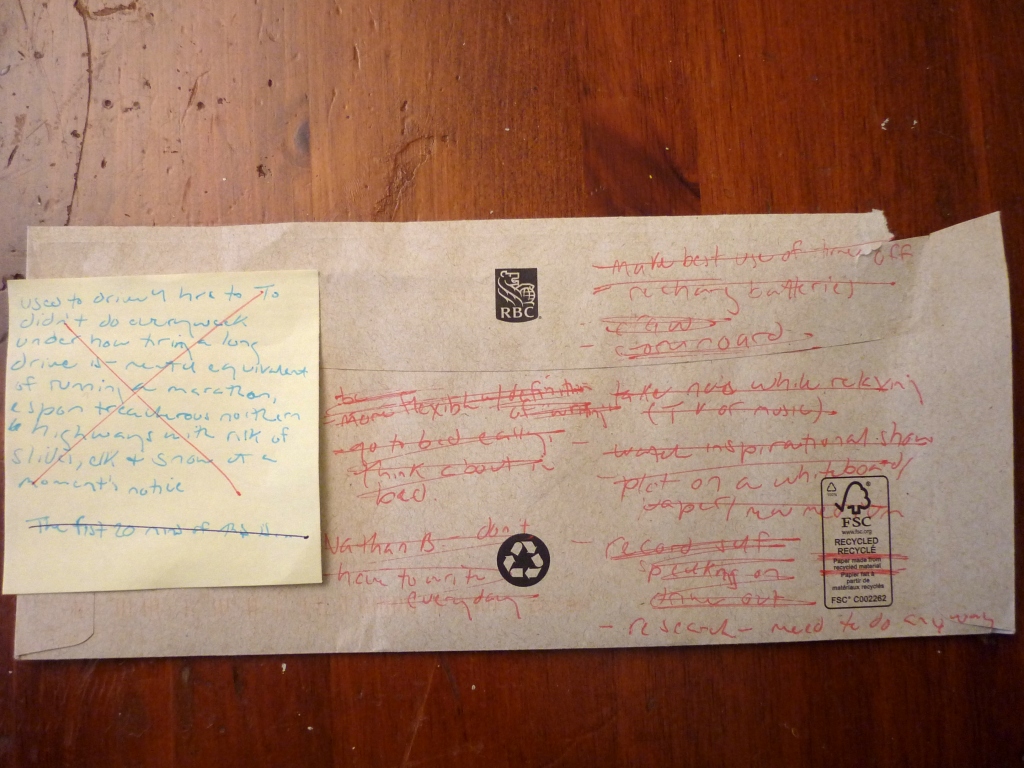
Continue reading

Different (Key)Strokes for the Same Folks

(Or, How To Come Home After a Long Day of Writing on the Computer, and Write Some More)

A Distractions & Subtractions post for Eric J. Baker

The computer age hasn’t been kind to writers.

Don’t get me wrong – in some respects, it’s been fantastic for writers: it allows us to use modern software with automatic formatting, connect with other writers all over the world via blogs, articles, and social media, and conduct research much more efficiently. (Does anyone even remember research of yore, using the card catalogue?)

Unfortunately, the computer age has giving comparable benefits to all other disciplines as well.  As such, computers have wormed their way into almost every aspect of modern life, not the least of which is our paid work.

Such is the subtraction of horror/dark sci-fi/supernatural writer and satirical essayist Eric J. Baker.  Eric actually works as a writer – a writer and editor of corporate documents – which right there screams massive quantities of time spend online.

Continue reading

Closing the Dictionary on the Definition of “Writing”

(Or, How to Write When You Can’t, Aren’t, or Don’t Want to be Writing)

A Distractions & Subtractions post for P.A. Wilson

I “wrote” this blog post during a three-day, writing-free recovery weekend after having worked eight days straight plus overtime.

When it comes to long-distance, solo driving, there are two things I know for certain:

  1. It’s a great opportunity to practice your singing, and
  2. It’s the mental equivalent to running a marathon.

This latter point is particularly true when it comes to treacherous, northern mountain highways with a high risk of sudden slides, snow, and wildlife, where night time comes quickly, and the route is more winding than a century’s old river bed.  Yes, I’m looking at you, Coquihalla Highway (BC Highway #5).

Years ago when I still worked in the natural resource conservation field, I had a job in a government-run park in rural southern Ontario located about four hours away from Toronto – a distance most of my colleagues and considered too long to drive on any weekends that weren’t long ones, no matter how much we yearned for bustle of the big city and to visit family and friends.

Vancouver-based thriller/mystery/fantasy author P.A. (Perry) Wilson might beg to disagree that such a distance being too long for weekly travel.  Once a week, for her work, she is forced to drive 10 hours round trip in a single day, part of said journey taking place on the above-lamented Highway#5.

Continue reading

Me, Myself & iPhone

Is your smartphone usage stifling your creativity?

In the spirit of full disclosure, I’ll admit right here that I’m a reluctant import into the world of Web 2.0 – not exactly a Luddite, but no early adopter either, not since Gmail first launched and you needed to be invited by an existing user to join.

I’m not on Facebook, I’m terrible at texting, the predominant activity I perform with my phone is talking on it, and I don’t own a smartphone (or rather, don’t own the corresponding data plan required to boost my phone’s intelligence quotient) because

a)  I don’t want to pay for it, and

b)  I couldn’t conceivably fit any more computing time into my day

Continue reading

The Gift of Boredom

The Fourth Rule of Engagement

We’ve all been there.

It doesn’t matter if you’re writing an essay for school, a “Dear John” letter to your soon-to-be ex-boyfriend/girlfriend/husband/wife/roommate from Hell, a letter of resignation, a last will and testament, or a manuscript that will someday outsell Harry Potter, Twilight, The Hunger Games, Fifty Shades of Grey, and the Bible combined.

At some point in the writing process, you find yourself a little bit stuck and unsure of what to write next.  You find that you need a bit of a break – just a short one – to give your brain a chance to catch its breath from all the mental calisthenics it’s been performing.  And so you click open your web browser, intent on just a quick peek at what’s been happening on the Web while you were busy spinning words into gold.

And then…

And then….

Continue reading

…But Fear Itself

Why do so many people who want to write – people who love writing, love words, love stories, and claim writing is their passion –  not actually do so?

I found myself pondering this question this week while running on the treadmill at the gym, and came to the conclusion that writing and physical exercise have much in common.

I made a similar comparison in my very first post on this blog, when I wrote that my creative muscles were out of shape, and that a mere 126 new words had strained them near to the breaking point.  But now I’m making a literal comparison.  Exercise is another thing that many people want to do – that everyone intuitively knows they should do – yet not everyone does.

I know why.  It’s not because of laziness.  With writing or with exercise.

Continue reading

Building a History – finale: Pages From Your Personal History

All fiction writing is historical fiction, even when it’s not….

Over the course of trying to learn how to be an effective writer, I’ve read numerous books, articles, and blog posts on all things to do with writing.

I continue to read blogs on writing to this day.  The majority of my study of nuts-and-bolts writing craft, however, occurred between the pages of this or the other book, and between 2001 and 2004, when I was first starting to take myself and my desire to produce publishable material seriously.

The years that followed afforded me numerous opportunities to really think about, internalize, and practice the various techniques I’d read about in the past.

They also caused me to often forget which books yielded which specific writing tips and ideas about the writing life.

One notion in particular for which I clearly remember the content yet not the source is the idea that whatever novel you’re currently working on is, in truth, the novel of your past.

Continue reading

On the Edge of Something Wonderful

I make a point of recording certain milestones while at work on my novel-in-progress.

I do so to track when I reach certain parts of the novel, both to measure the consistency of my output and for reminiscence.  I also do it to encourage further progress and the achievement of additional milestones.

The specific milestones I’ve chosen to observe are as follows:

  • Page 50 of the novel
  • Page 100 of the novel
  • Every page that is a multiple of 100
  • The approximate midpoint of the novel
  • The end of every chapter

Currently in my novel, I’m about five words away from rolling over onto page 100.  I’m also about half a page away from the end of a chapter.  One might suppose I’m feverishly working away on achieving two milestones within such a short space of each other.

But I’m not.

Instead, I’m rather preoccupied with another pursuit.

Once I finish with this one, I’ll gladly return to writing.  In the meantime, though, I find myself on the edge of something else that’s wonderful.

——————–

Related post: No Better Place (for Writing)

“Don’t steal my armrest! Quit wrecking my night vision!” (or, Why I Might Have to Stop Going to Concerts)

I am a music lover.

As I mentioned for one of the seven things about me when I was nominated for the Versatile Blogger Award, music is both the filing cabin and the encyclopedia of my mind.  It helps me make sense of my life through my tendency to categorize and understand my various experiences according to specific lyrics or sounds.

Music is also intrinsically tied into my writing life, for I can’t write well without it, and it likewise inspires my daydreams, my imagination, my stories.

My love of music was one of my largest motivators for finally giving up on shared living last year and getting a place on my own, for I couldn’t play my stereo at 6:30am since my roommates didn’t get up that early.

My love of music also resulted in a 30km-journey to the suburbs by public transit to buy a pair of high-end second-hand Harman/Kardon speakers.  I hate public transit.  I’m not wild about the suburbs either.  But I believe that true enjoyment of music is obtained, not through earbuds, but when it’s played aloud and you can feel it in your solar plexus and the soles of your feet.

Hence, my love of concerts.

Continue reading

Building a History

(A/N: Post title is a play on the song Building a Mystery by Sarah McLachlan.)

I never planned to become a writer of historical fiction.

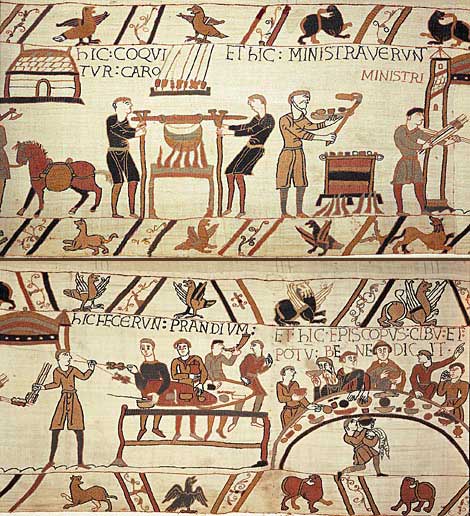
Cooking and feasting – The Bayeux Tapestry, circa 1070, England

From what I gather from various authorities on the matter, no sane person ever would.

When I first started taking myself seriously as a writer and writing with a view to someday attempt getting my work published, fantasy was my genre of choice.

Fantasy, after all, was the genre unbounded by the rules of the modern world, and even the natural world.  It was the genre in which anything could happen so long as it was properly motivated and followed some manner of internal consistency.

It was the genre in which you could make your own rules.

Continue reading