The Incredible Shrinking Blog Post

Brevity, it’s true, has never been my strength – not when it comes to writing.

In 1999, while in university studying ecology, I had one particular class that came with very specific instructions regarding the format for our laboratory reports.  They were as follows:

  • Double-spaced
  • Times New Roman font
  • 12 point font size
  • 1-inch margins
  • 6 complete pages

For most of my classmates, the problem was always managing to fill the entire six pages.  They would contrive all sorts of strategies: big, blocky tables; subheadings with spaced-out titles; a blank line above the page numbers.

Me – I had the opposite problem: I always needed just a little more room.

So, I contrived a strategy of my own.

This was in the early years of Windows-based word processing programs (as opposed to DOS-based), and a time when Microsoft Word had started gaining greater market share than its rival, Corel WordPerfect.

I’d been a loyal WordPerfect user since its white-on-blue-screened DOS iteration of 1993 (full disclosure: I still WordPerfect) despite the university being a Microsoft-centric campus.  I thus had both WordPerfect and Word on my 1999 computer.

And I chanced upon a discovery: WordPerfect permitted fractional font sizes, while, at that time, Word did not.  That meant that using WordPerfect, I could shrink my font size to 11.8 point (which showed little visual difference from 12 point), and subsequently gain about 3 extra lines of text.

I did this on every single lab report.

I’ve mentioned in one of my earliest posts that I possess what I refer to as the “verbosity gene”, which often leads me to write things twice as long as they’re meant to be.  Exhibit A: My novel-in-progress is actually a novel in two volumes.

Exhibit B: My blog posts.
Continue reading

No One Would Make a Coconut Fluoride Rinse: A writer’s frustration with finding the right words

A Distractions & Subtractions post

So, I have this sort of condition….

It’s nothing overly serious – nothing requiring medical treatment or that’s even been officially diagnosed.  More than anything, it makes for something of an odd party trick in response to yet another game folks may play at a party.

The blindfolded, guess-what-food-I’ve-just-put-in-your-mouth game.

Yes, this does, indeed, relate to writing.  Everything does with me, dontcha know?

Continue reading

(Writing) Location, Location

(Or, Why I Can’t Write in Coffee Shops, in a series of confessions)

A Distractions & Subtractions post

There are only two places that I ever do any writing:

  1. On my bed, lying prone, or
  2. Sitting at my dining table

As both of these pieces of furniture are in my apartment, I guess, technically, they count as only one writing place.

Allow me to start again:

There is only one place that I’ll ever do any writing….

This is not to say I’ll only take writing notes at home.  Rather, I’ve done this at work, on transit, on the sidewalk, in the grocery line, on my bike (not while in motion, of course; safety first), and a multitude of other locales.  Indeed, it’s my willingness note-write anywhere (and everywhere) that allows me to write-write anything at all.

But of that write-writing – the actual construction of sentences and paragraphs, foreshadowing and figurative speech – at my humble abode is the only place I can make the magic happen.

Whether I like it or not.

Which I didn’t always….

Continue reading

Writing to the End of My Rope

A Distractions & Subtractions post

A/N: I’m making my way through my Distractions & Subtractions posts.  I only have four more to go after this: two for me and two for my blog readers and followers.

It’s not too late for other readers/followers to submit their own writing subtractions.  I’ll write a blog post for anyone who does.  Who doesn’t want a blog post written in their honour.

Today’s post is one of my own subtractions.  Coming up next week: a post for national/international award winning Australian author Dianne Gray.

—————————————————————————————————-

If you were to visualize yourself in the act of writing, what would it look?

I’ve written about the power of visualization a fair bit here in the past few weeks: about how I every day visualize the sentences and paragraphs I plan to write that night.  About how some personalized visualization can help induce an altered state – can help trick the mind into believing that computer time spend working on your work-in-progress isn’t just more staring at a screen after a long day of doing just that at work.

Someone visualizing him-/herself writing might call up that same imagine of being bend over a computer keyboard, typing up a storm.

Someone else might envision him-/herself writing longhand in an elegant notebook, or frantically scratching down a lightning flash idea or line of dialogue on the back of a grocery store receipt.

Yet another person might see the scenes of his/her WIP unspooling before his/her mind’s eye, like the frames of a movie.  Someone else still might imagine all of the above.

For me, my images of myself in the act of writing are perhaps a little more esoteric:

Continue reading

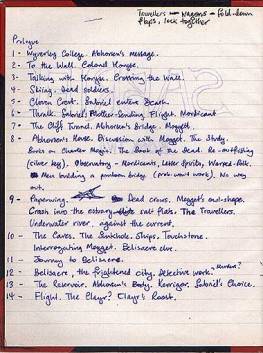
Writing Inside the (Out)Lines

A Distractions & Subtractions post

A/N: Check out my Distractions & Subtractions page to read related posts or to submit your own writing subtractions.  I’m writing a blog post for everyone who makes a submission.

Today’s post is one of my own subtractions.  Coming up next week: a post for horror/dark sci-fi/supernatural writer and satirical essayist Eric J. Baker.

—————————————————————————————————-

There are many different types of writers producing many different types of writing in many different ways.

Yet, if you examine this creature known as “the writer” at its broadest taxonomical subdivision, you’ll find that most of them can be categorized into one of two main groups:

Plotters.

Pantsers.

Pantsers write by the “seat of their pants”.  I’ve also heard pantsers referred to as “discovery writers” – seemingly a euphemism to make what can nonetheless be a perfectly orderly process sound less disorganized.

Plotters make outlines and do pre-writing, sometimes in massive quantities.  I’ve never heard of any other name for plotters, although that two can be interpreted as one of two extremes: Plot, as in a cunning, sexy, leather-clad precision.  Or plot, as in a burial plot.

Continue reading

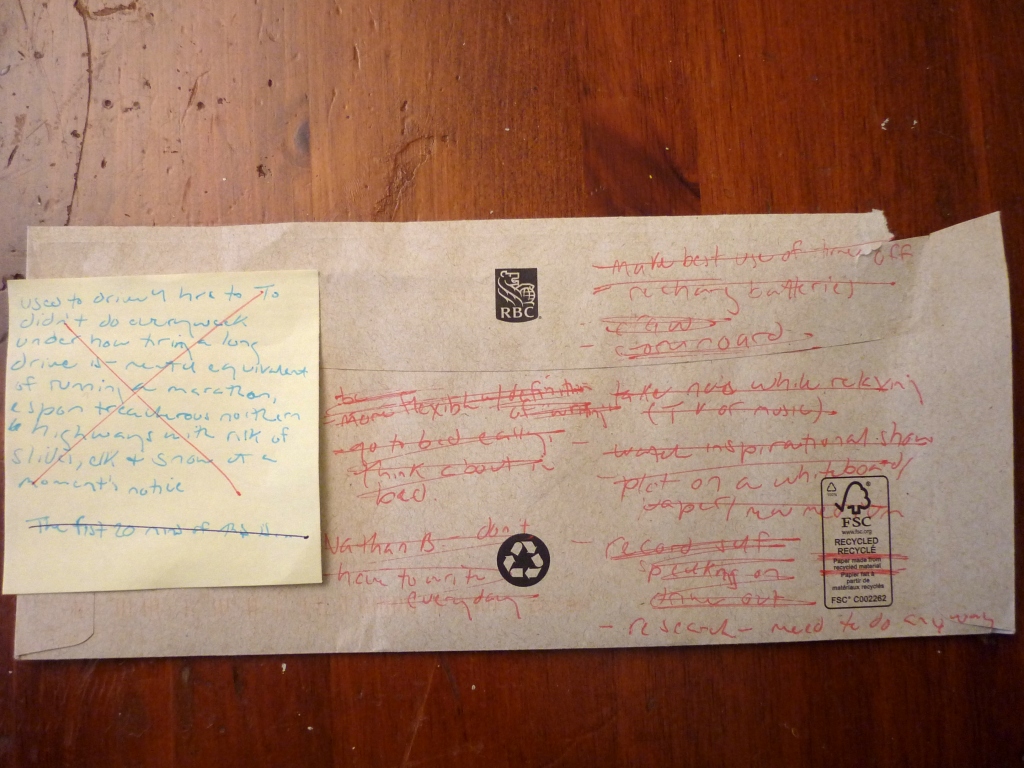
Closing the Dictionary on the Definition of “Writing”

(Or, How to Write When You Can’t, Aren’t, or Don’t Want to be Writing)

A Distractions & Subtractions post for P.A. Wilson

I “wrote” this blog post during a three-day, writing-free recovery weekend after having worked eight days straight plus overtime.

When it comes to long-distance, solo driving, there are two things I know for certain:

  1. It’s a great opportunity to practice your singing, and
  2. It’s the mental equivalent to running a marathon.

This latter point is particularly true when it comes to treacherous, northern mountain highways with a high risk of sudden slides, snow, and wildlife, where night time comes quickly, and the route is more winding than a century’s old river bed.  Yes, I’m looking at you, Coquihalla Highway (BC Highway #5).

Years ago when I still worked in the natural resource conservation field, I had a job in a government-run park in rural southern Ontario located about four hours away from Toronto – a distance most of my colleagues and considered too long to drive on any weekends that weren’t long ones, no matter how much we yearned for bustle of the big city and to visit family and friends.

Vancouver-based thriller/mystery/fantasy author P.A. (Perry) Wilson might beg to disagree that such a distance being too long for weekly travel.  Once a week, for her work, she is forced to drive 10 hours round trip in a single day, part of said journey taking place on the above-lamented Highway#5.

Continue reading

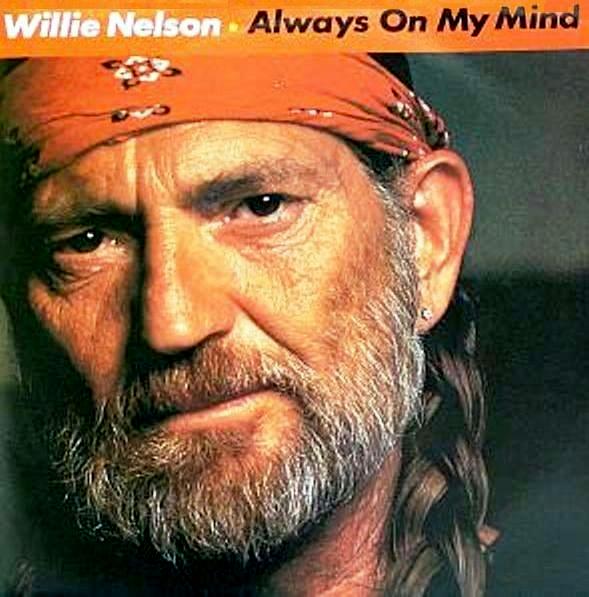
Always On My Mind (Time Permitting)

Okay, picture it: it’s 7am, and you have to leave for the day within the next half an hour.

Willie would be so disappointed in me.

Willie would be so disappointed in me.

What essentials do you bring with you to get you through the day?

A bag lunch?  Your phone?  Your mp3 player if that’s separate from your phone?  Something to read?  Any of the other following useful items:

  • A pocket knife
  • An extra pair of socks
  • Sunglasses
  • Legwarmers
  • Rain gear
  • Ibuprofen
  • Water
  • Eyeglass cleaner solution
  • A handkerchief
  • Lip balm
  • A USB drive?

Almost all of the above-mentioned are things I carry with me on a daily basis.  Even sunglasses, which I wear all year round, and legwarmers, which are a must in Vancouver, for once the sun goes down, the temperature plummets with it, even in the summer.

But perhaps the very most important thing I pack for a day away from home – something that’s not on the above list due to its lack of material form – is a piece of a story (usually my novel-in-progress, but not necessarily) to think about over the course of the day.

Continue reading

Writing Distractions, Writing Subtractions … and (hopefully!) Blog Reader Participation

Sometimes, I think I’m optimized to be a writer.

Not that I believe there’s some magical blueprint out there on How To Build an Ideal Writer (“follow these steps ten easy steps and water twice a day”), nor do I believe that an ideal writer is made in only one way, for the world is full of writers, and all of them possess their own particular way of doing what they do best.

Yet, I definitely believe that certain aspects of my personality, temperament, and behaviour contribute positively to my writing endeavours, at least the way I endeavour to do so:

  • I have a very long attention span
  • I can physically sit still for long periods of time
  • My brain naturally amuses itself by telling stories
  • I’m an unrepentant daydreamer
  • I’m curious about people’s inner lives
  • I have a strong vocabulary
  • I believe the best way to explain something is through a story
  • I’m all about delayed gratification

Continue reading

How to Write a Sex Scene

That got your attention, didn’t it?

(A/N: For the purposes of this post, I am defining a sex scene as one in which sexual activity is explicitly described, rather than those of the fade-to-black, implied sex variety.)

I was too scared to type the words “sex scene” into a Google Image search, afraid it’d result in a reaction similar to this.

Sex scenes are among the most difficult scenes to write.  Part of this is because doing so in one way or the other reveals to the world what you find sexually appealing, either through what happens in a sexy sex scene or what doesn’t happen in an intentionally unsexy one.

In North American culture, sharing your sexual turn-ons with people you haven’t even met (in this case, readers) isn’t something people tend to do, at least not using their real name or one by which they can otherwise be traced.

Furthermore, sex scenes have a far greater potential than other types of scenes to read as unintentionally humourous, repulsive, or cringe-worthy embarrassing.  Not to mention they require some pretty exact choreography.

Continue reading

Building a History – finale: Pages From Your Personal History

All fiction writing is historical fiction, even when it’s not….

Over the course of trying to learn how to be an effective writer, I’ve read numerous books, articles, and blog posts on all things to do with writing.

I continue to read blogs on writing to this day.  The majority of my study of nuts-and-bolts writing craft, however, occurred between the pages of this or the other book, and between 2001 and 2004, when I was first starting to take myself and my desire to produce publishable material seriously.

The years that followed afforded me numerous opportunities to really think about, internalize, and practice the various techniques I’d read about in the past.

They also caused me to often forget which books yielded which specific writing tips and ideas about the writing life.

One notion in particular for which I clearly remember the content yet not the source is the idea that whatever novel you’re currently working on is, in truth, the novel of your past.

Continue reading